I've chased the perfect beef jerky texture for a while, and have messed up enough batches of beef jerky following online recipes to know that temperature matters. Not just for food safety, but because it completely changes the texture of your final product.
Ever since I started with my first batches, I wanted a final product that's tender and easy to rip apart - but dry as anything. Most recipes and discussions will suggest that you dry your jerky at the minimum possible temperature - for instance, Alton Brown suggests you dry your jerky at room temperature. Many suggestions online try to compensate with other ways of denaturing the meat proteins - such as adding extra salt, vinegar, and pineapple/papaya.
Personally, I find this whole approach of being afraid of "cooking" your jerky to be a bit of an old wife's tale, and instead would urge you to follow the science that BBQ adheres to. So, what's the trick?
It's all about the collagen
Beef has collagen. Lots of it, though most budget cuts have more - that makes cuts tougher and chewier. When you're making BBQ, you're basically trying to denature this collagen and break it down into gelatin for tenderness. This happens at 160°F (71°C).
And that's the magic number for a perfect beef jerky texture is 160°F (71°C), not a degree less than that. I dry mine at 167°F (75°C) as my set-up doesn't allow for by-one-degree temperature control.
At this temperature, the collagen starts breaking down without the proteins seizing up too hard. You get:
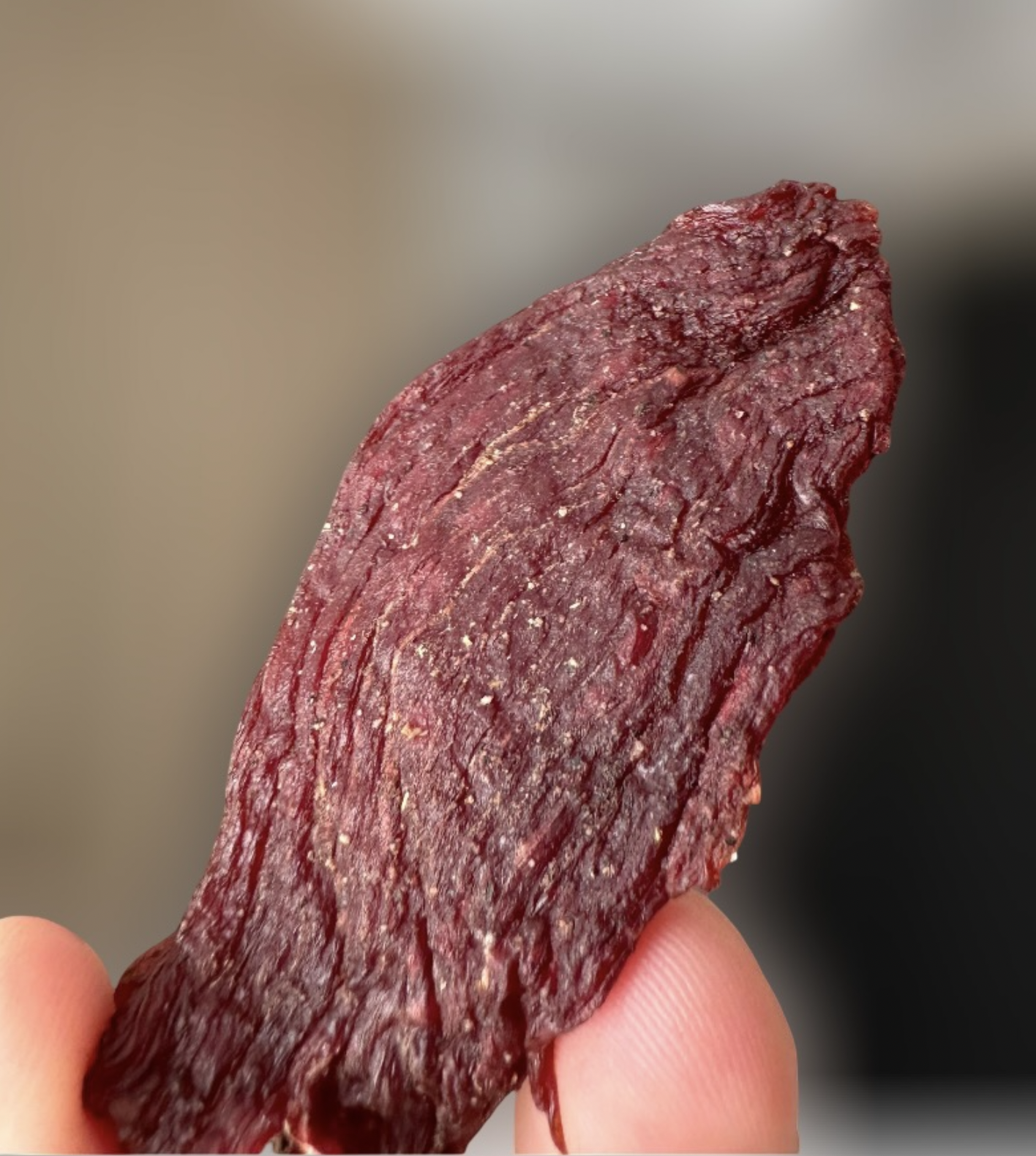
- In my opinion, the best texture - tender enough to bite through easily, is easy to rip apart, but still has a satisfying chew. It's also very dry in the sense of moisture within the beef, but not in a tough-to-chew kind of way - more of a pleasantly crumbly way.
- Even drying - the heat penetrates consistently without case-hardening the surface.
- Food safety - you're well above the temperature needed to kill the bad stuff.
If you go lower than this - say, you're drying at 140°F (60°C) - or even a degree below 160°F (71°C) - the collagen stays intact. Your jerky will be like chewing on leather straps. This might be your thing and in that case, lower temps are completely valid! But to me, this is not the good kind of chewy.
Go way higher - like 80°C+ (175°F+) - and you're cooking the outside too fast. The surface hardens, traps moisture inside, and you end up with jerky that's has a hardened case.
That's it. Get your dehydrator/oven/smoker between 160°F (71°C) and 167°F (75°C), let it run for 3-5 hours depending on thickness, and you'll have beautiful, tender jerky that is satisfying to rip apart and doesn't require jaw muscles of steel to eat.
🧮 Calculate Your Marinade
Take the guesswork out of your jerky marinades. Calculate the salinity & sweetness with MarinadeBuddy.
Go to MarinadeBuddy.com calculator page